
Jersey City Times: Boyle’s Thirty Acres: When Jersey City Was the Center of the Boxing World

This is the first in a weekly series of essays on Jersey City’s illustrious sports history. It complements the Museum of Jersey City History’s current exhibit Legendary Arenas… and the Legends Who Performed There at the Apple Tree House (298 Academy Street). The exhibit is open to the public on Wednesdays and Saturdays from 1:00 to 5:00 pm. until October 15.

Boyle’s Thirty Acres: When Jersey City Was the Center of the Boxing World by Peter Begans Jersey City Times July 11, 2025
One of the all-time great boxing arenas was constructed on former marshland west of Downtown Jersey City. The world remembers it as Boyle’s Thirty Acres (technically, it measured 34 acres), since it was owned by industrialist John F. Boyle, a friend of Jersey City Mayor Frank Hague. The massive amphitheater was created specifically to showcase “The Fight of the Century” ― the World Heavyweight Championship bout between champion Jack Dempsey of the United States and challenger Georges Carpentier of France. The spectacle was scheduled for July 2, 1921.
Remarkably, the enormous octagonal arena was built in just two months by 500 carpenters and 400 laborers, employing more than two million feet of lumber. The “Pine Bowl,” as it was called, cost $250,000 to complete, paid to contractors C.S. and J.W. Edwards, who were brothers of Gov. Edward Edwards. It claimed to have had the greatest seating capacity of any amphitheater ever built.

Tex Rickard, the top fight promoter of his day, initially wanted the championship bout to take place at New York’s Polo Grounds. But New York Gov. Nathan Miller opposed prize fighting in his state. Instead, Rickard took his quest to New Jersey where Mayor Hague, himself a former boxer and fight manager, outbid several other cities to obtain the event.
Hysteria surrounded the Dempsey–Carpentier match from the initial announcement. People from all walks of life were fascinated by the matchup between the brutish Manassa Mauler and the dashing French war hero, who was also the World Light-Heavyweight champ. Among the more than 90,000 spectators were Vanderbilts, Roosevelts, Astors, and Fords. The intense interest translated into sport’s first million-dollar gate (nearly $1.8 million, quadrupling the best fight gate up to that time).

The fledgling Radio Corporation of America created a network of amateur and professional radio enthusiasts throughout the Eastern United States. J. Andrew White, sitting at ringside, transmitted a blow-by-blow description of the fight to his associate J.O. Smith located at the Lackawanna Railroad office in Hoboken, next to a huge GE transmitter. Smith, on temporary radio station KJY, repeated White’s call of the fight to audiences in 61 cities, where fans assembled in halls and clubs to listen to the transmission on loudspeakers. It was the first network broadcast of a heavyweight championship fight. The event was also filmed by several cameras and eventually shown throughout the country to packed movie houses.
Not only was Carpentier 16 pounds lighter and 1.5 inches shorter, but in the second round he would break his thumb on a stiff punch to Dempsey’s head, and the Frenchman was at a severe disadvantage from then on. Dempsey would knock Carpentier down, and then out, in the fourth round. Other notable matches that day included two popular Jersey City fighters: Frankie Burns and “Irish” Johnny Curtin. Both won their undercard matches, and both would go on to be rated among the best fighters in New Jersey history.

During its short lifespan, Boyle’s Thirty Acres hosted other outstanding boxing cards. On Labor Day, 1921, four champions ― Johnny Wilson, Panama Joe Gans, Mike McTigue, and New Jersey’s Johnny Buff – shared top billing. On July 27, 1922, the lightweight champion Benny Leonard defeated challenger Lew Tendler in a match between two of the era’s top Jewish boxers. On July 12, 1923, Luis Ángel Firpo, nicknamed “The Wild Bull of the Pampas,” knocked out ex-champion Jess Willard to earn a title shot at Jack Dempsey. However, a year later Harry Wills, the World Colored Heavyweight Champion, would defeat Firpo before 70,000 fans.
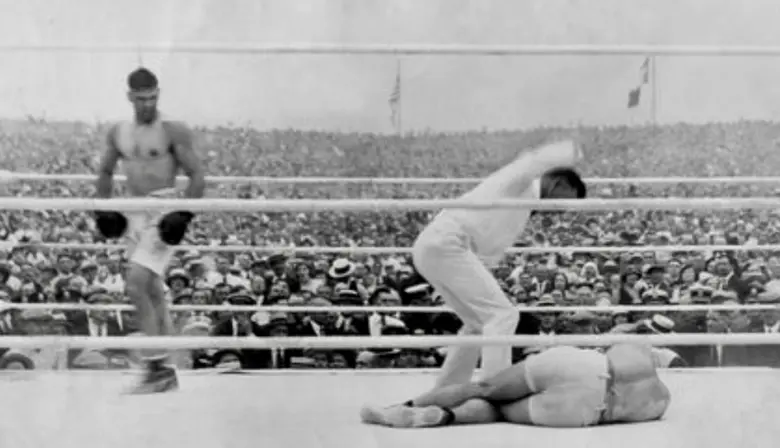
Even future Heavyweight Champion of the World James J. Braddock, a local product from North Bergen, would fight at Boyle’s Thirty Acres. But by 1927, New York, with its giant baseball stadiums and a more favorable disposition toward the sport of boxing, had taken back most major title bouts. Promoter Rickard announced he was selling off the acres of weathered lumber in Jersey City, bringing the short era of Boyle’s Thirty Acres to a close.
The area encompassing the “Pine Bowl” would be replaced by Jersey City High School Field where football and baseball were contested for decades. It was later parceled into Montgomery Gardens, a public-housing project that has now given way to lower-density housing, and the Hudson County Schools of Technology’s High Tech High School.
Peter Begans is the curator of MJCH’s Legendary Arenas… and the Legends Who Performed There. He was born and raised in Jersey City and has had a long career as a teacher, journalist, speechwriter and public affairs representative.


Comments